
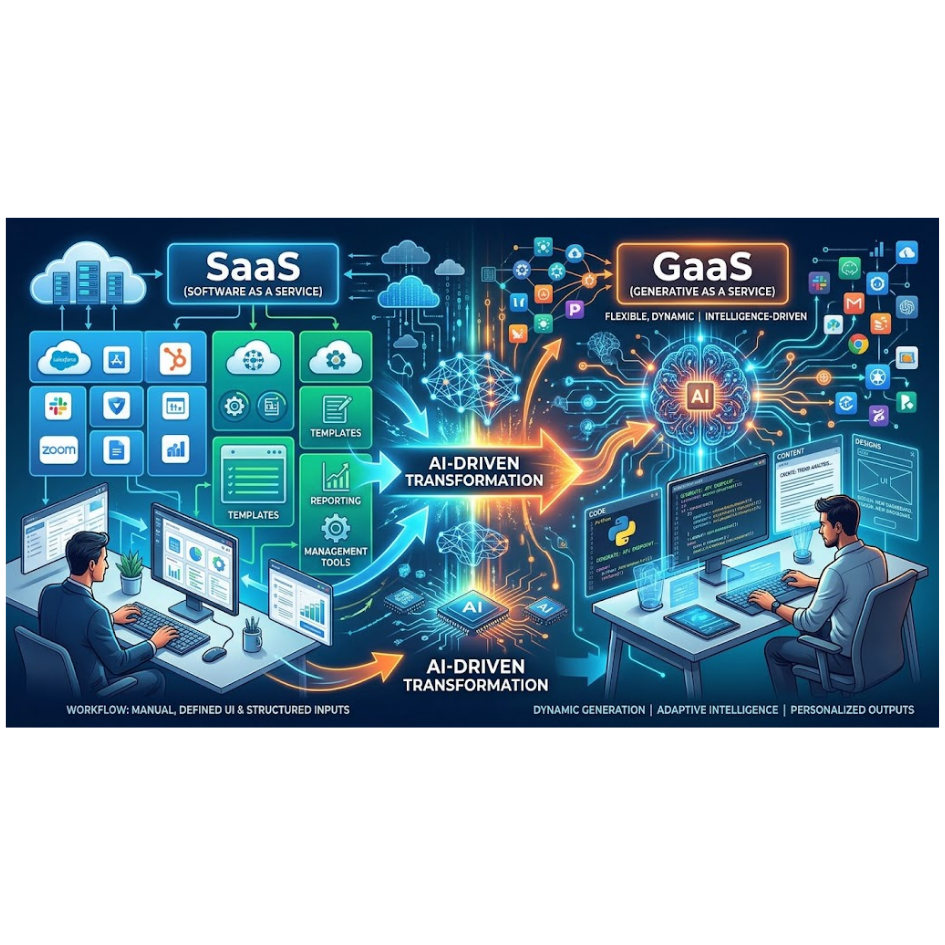
Software used to be something you opened. Soon it will be something that works while you focus on everything else. That is the idea behind GaaS, or Generative Agent as a Service, and it is quietly reshaping what SaaS means.
Let us get straight to the point.
SaaS gave you tools. GaaS gives you results. With SaaS, you pay for a platform and your team runs it: log in, click, type, export, repeat. With GaaS, an AI agent does the running. It plans the steps, uses your existing tools, checks its own work and hands over the finished job.
Nvidia CEO Jensen Huang sees it this way too. He does not believe software is going away, and he told CNBC that “the markets got it wrong” when they panicked. His point is that agents will use tools like browsers and Excel on our behalf instead of replacing them. At the same time, he predicted that “every SaaS company will become an AaaS (Agent-as-a-Service) company.” You will see this idea called both AaaS and GaaS, but the meaning is the same.
So SaaS is not dying. The way we use it is.
What Actually Changes
First, you stop operating and start instructing. Instead of opening a dashboard, you give a goal, such as reply to every new lead within five minutes. The agent handles the rest. Think of a support ticket. In the old model, a person reads it, checks the order, issues a refund and writes back. In the GaaS model, the agent does all four steps and only calls a human when something looks unusual.
Second, you stop paying for seats and start paying for outcomes. For two decades, more employees meant more licences. That link is breaking. Seat based pricing dropped from 21 percent to 15 percent of SaaS pricing models in a single year, and HubSpot, Zendesk, Salesforce and ServiceNow are all moving toward outcome based or usage based pricing. Your bill starts to follow your results, not your headcount. hatchworksforkast
Third, software is built for agents, not just people. Software will increasingly need to work with AI agents directly, not only with humans clicking buttons. That means clean connections and open access matter more than a pretty screen. beehiiv
Fourth, software starts to feel like staff. Companies lease digital employees instead of buying tool subscriptions. You are no longer buying a hammer. You are hiring someone to build the shelf. medium
The Numbers Say It Is Already Happening
Gartner estimates that about 234 billion dollars of enterprise software spending, roughly 20 percent of enterprise SaaS spending by 2030, is at risk from agentic AI. Early in 2026, AI native spending grew 94 percent year on year, while traditional SaaS grew about eight percent. Gartner itself calls this shift less an apocalypse and more of a metamorphosis.
A Quick Reality Check
GaaS is powerful, but it is not magic. Agents with vague roles, loose instructions and no checking will make confident mistakes, just like the multi agent failures we covered in our earlier post. The winners will be the teams that set clear goals, keep a human checkpoint for sensitive steps and measure the results.
If you want to start, keep it simple. Pick one repetitive workflow, such as lead follow up, invoicing or support replies. Automate that first, track the time saved, and grow from there.
SaaS is not disappearing. It is growing up, from a tool you operate into a teammate that delivers. At AT Web Technologies, we help businesses build that kind of practical automation, designed around real goals and tested honestly. If you are curious where an AI agent could save your team hours each week, we would be happy to talk.